
Established in 2007 under the Jordan River Child Safety Program (JRCSP), 110 for Families and Children[s1] is a free child helpline that aims to empower the child and family in order to promote and protect the well-being and safety of children in Jordan. Based on confidentiality, active listening, and unconditional acceptance, counselors communicate with the caller, whether a child or an adult, providing psychological support, guidance and information where required. When additional and more in-depth services are needed, referrals are made to institutions which provide the required services.
The Helpline emerged after a persisting need among Jordanian families for consultations related to their children’s development, be it physical, psychological, social-emotional, or educational. Although several organizations provide such services across Jordan, the exact number of these services for each region is unclear to the public, and so 110 for Families and Children came about to organize the collective efforts of these organizations through a single phone call.
Today, the Helpline is a member of the Child Helpline International (CHI); an international network of child helplines in 160 countries around the World.
Our Core Values:
- Social Justice: no caller is denied service based on age, gender, religion, ethnicity, culture, socioeconomic status, ability, or other. The Helpline is also committed to advocating on behalf of children in pursuit of social change.
- Person-centered practice: Counselors actively listen to callers and respect callers’ needs, priorities, and decisions.
- Empowerment-based approach: Counselors emphasize callers’ strengths and resources, and encourage them to take action in attaining the changes they aspire for.
- Tolerance: Counselors accept and respect callers despite differences in opinions, values, or decisions.
- Competence: Counselors provide services only within their area of expertise, and stay informed on issues related to the callers they serve.
- Confidentiality: Counselors do not share any information related to callers without the caller’s consent (restrictions apply where there is evidently eminent danger to a child). Callers can choose to remain anonymous or confidential.
- Family perspective, child focus: Counselors appreciate the family’s role in the healthy development of children and manifest the Convention on the Rights of the Children in their practice.
How We Help Callers:
Counselors provide children with a safe place to turn to for support; they allow children the opportunity to talk, build trust, and share their experiences no matter how minor or major they might seem. Parents can also call to discuss their concerns for their children, receive parenting guidance, or simply to vent about their struggles, or share the joy of parenthood.
Since our major goal is empowering the caller, callers are encouraged to be proactive and to mobilize whatever helpful resources they may already have at their disposal. Thus, the caller seizes opportunities and makes use of resources that are already within reach. If additional services or resources are needed, they can be referred to whatever entity will provide them with these services.
In more severe cases, some children may want to report abuse but are unable to reach responsible authorities like the Family Protection Department; others may not yet be ready to report abuse to authorities but would like a chance to disclose and work through their experiences. Either way, the Helpline assists the child in facing his/her particular circumstances, and facilitates the reporting of abusive incidents if the child wishes to do so, or when the child is under substantial risk.
Connecting the Caller to Needed Services:
In cases where there is a need for additional services (i.e. legal consultation, psychosocial intervention, special education programs, among others), the Helpline staff work to allocate the most appropriate and accessible (both geographically and financially) service needed for a specific caller through a database compiled for this purpose. The Helpline then facilitates the process by linking callers to the allocated service provider, and then follows up with both the caller and the service provider.
Reaching Out:
As part of its strategy, JRCSP has used several mechanisms to raise awareness on the Helpline service and in turn reach out to more beneficiaries. To this end, the Helpline utilizes outlets where targeted populations are present, including schools, and health and community centers. In collaboration with the children themselves, the Helpline has produced flyers, posters and vignettes depicting conversations between children in different situations where they might need to call the Helpline.
Moreover, the Helpline has conducted many awareness raising activities targeting specific populations, such as Iraqi refugees. During its first two years of existence, the Helpline covered the capital Amman and extended to the Zarqa Governorate. Plans to expand the Helpline’s outreach are underway, and because the support of several partner organizations for the provision of services is necessary, this expansion will take place geographically and gradually as strong partnerships are built.
Our Team:
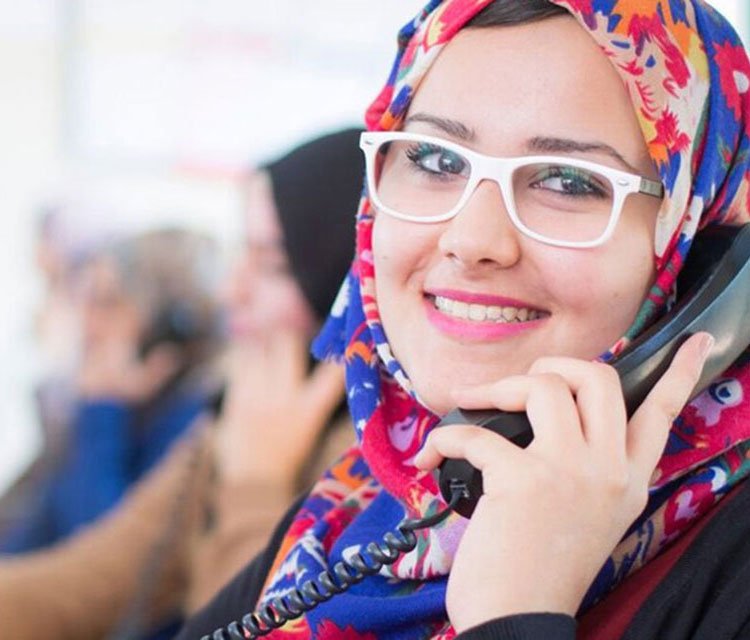
Our calls are handled by volunteers, mostly university interns who are completing their studies in a relevant field, such as psychology or counseling. All our volunteers undergo an intensive training program designed to equip them with the required knowledge and skills to respond to callers effectively. Volunteers are supervised by a staff member at all times to ensure and maintain the quality and confidentiality of services. These staff members oversee the daily operations and performance of the Helpline, and when needed, they are available to intervene with a difficult or high-risk case, or to offer consultations to the volunteers where referrals or urgent action is needed. Our staff receives ongoing training and capacity building opportunities so as to remain up to date on issues affecting our callers.
Our Partners:
To support our endeavor and our capacity to provide better services, JRF has established partnerships with the following governmental, private, and voluntary entities:
- Ministry of Education
- Ministry of Interior
- Ministry of Social Development
- Ministry of Health
- Ministry of Labor
- Public Security Directorate
- Higher Council for the Affairs of People with Disabilities
- The Jordanian Hashemite Fund for Human Development
- Jordanian Women’s Union
- Law Groups for Human Rights (MIZAN)
- Sisterhood is Global – Jordan Chapter
- Cerebral Palsy Foundation
- Orange
- Zain
- Umniah
How to Reach Us:
The Helpline can be accessed from any landline or mobile network in Jordan, thanks to partner telecommunication companies, and is free of charge. Our number - 110 will not appear on your phone bill and your number will not appear on our screens. Reaching us is that easy; all you need to do is pick up the phone and dial 110.